
Feedback report
How your audience reacted
to uralabs.app
Result
Next step: TEST YOUR PAGE FREE
About half would act
All of these visitors were new to UrA. The page clearly works for hands-on paid-acquisition marketers and cash-strapped founders who fear sending ad spend to a leaky page. For them, the free, no-card test with results in minutes makes trying it nearly risk-free. The sample report, with its per-archetype fit scores and ranked quick wins, is what pulled many of them in. Those who held back, and many who signed up anyway, hit the same wall: the MIT, Harvard, Bain and Gallup strip proves synthetic respondents work in general, but nothing shows UrA's own predicted conversion next to a real campaign's results. A second group of heads of growth, agency owners, UX researchers and B2B marketers also bounced for buyer-specific reasons: no shareable or white-label report, no security or data-handling statement, and no sign they can define their own ICP.
Average chance that people in this audience take the page's next step, across 100 people. Repeat runs with the same audience land within ±5 points; smaller differences between two runs aren't meaningful.
Top reasons it lost people
- 01Trust & Credibility38%
- 02Clarity of Free Tier & Scores16%
- 03Security & Methodology14%
Share of all objections raised in the audience’s feedback.
What the audience said
100 people · 61 would act · 39 held backSix voices from different audience types: three who would take the next step, three who held back.

Ad-Spend Guardian
Would act
“actual conversion on a real campaign, and I couldn't tell whether I can aim personas at my actual Meta lookalike or search-intent audiences.”
Normally I'd just burn $500 on a test campaign and eat the loss, so something that tells me which blockers will kill a page before the spend is exactly what I'm hoping to get out of this. What I want from a free run is a ranked fix list that goes beyond "add social proof" and "shorten the form," plus some sign that the fit scores track real CVR. The free tier with no card and results in minutes gets me to click, since the downside is basically zero. The research logos and the sample report help, but nothing on the page shows predicted vs. actual conversion on a real campaign, and I couldn't tell whether I can aim personas at my actual Meta lookalike or search-intent audiences. I'll probably
Add a short section with one or two real before/after examples: "predicted 3.1% CVR, live campaign hit 2.8%," with the page and traffic source named. Also add a line saying whether you can define personas by ad platform audience or search intent.

Ad-Spend Guardian
Held back
“None of it is UrA's own scores checked against real CVR from live campaigns, and that's the only proof that would make me trust a "44% persuaded" number.”
No predicted-vs-actual numbers anywhere, and that's the thing I went looking for. I got university logos and "research is public" links, but those are academic studies on synthetic respondents in general. None of it is UrA's own scores checked against real CVR from live campaigns, and that's the only proof that would make me trust a "44% persuaded" number. I almost bounced at the sample report. The top quick wins were an integration strip, a verified dispute rate and payment methods listed next to checkout. That's close to the generic add-proof-and-clarify advice I already get from every CRO audit, so I didn't see why this beats a decent teardown. The free button and the "no credit card" lin
Add a section with 3-5 real pages showing UrA's predicted conversion rate next to the actual live-campaign CVR, with the sample size and the gap, and put a line under the free button saying how many credits one full analysis uses out of the 500.
Scrappy Pre-Launch Founder
Would act
“What I want next to the free button is what I get free, how many credits one run burns (500 free credits, but what does a run cost?)”
This reminded me of those "predict your conversion rate" tools from a few years back that gave you a score and zero explanation. But the sample report here is actually specific: blockers by percentage, fit by archetype, quick wins with lift numbers. I'm a scanner, so I'd cut the research-logo strip right under the hero. It's four big institution names before I've seen what the product does, and it reads like borrowed authority. Those logos belong to general synthetic-audience research, not to UrA's own accuracy. What I want next to the free button is what I get free, how many credits one run burns (500 free credits, but what does a run cost?), and whether it can make sense of a weird new cat
Replace the logo strip with a one-line note under the hero button: "Free = 1 full report from your URL, about X minutes, uses Y of your 500 credits." Then put a short real persona chat excerpt right beside it.

Methodology Skeptic CRO Specialist
Held back
“Credits on a free trial, and I can't tell what a full run actually costs me.”
The pricing is where I paused. Credits on a free trial, and I can't tell what a full run actually costs me. If 500 credits covers one analysis, that's a demo, not a trial. The $29 tier at 1,000 credits a month might be two runs, and I can't judge ROI against a $5k focus group or a few A/B tests without knowing that. I almost bailed at the "validated" line near the top, since it's attached to nothing. The logos for MIT, Harvard, Bain and Gallup read like borrowed credibility. They link to general research on synthetic respondents, not to URA's own personas tested against real conversion outcomes. The 44% predicted rate in the sample report looks nice, but I have no idea whether that number ha
Put a "validation" block right under the hero: URA's predicted vs. actual conversion rate on N real pages that were also A/B tested, with the correlation, sample size and method. Link the full write-up, and say next to the button how many credits one full analysis uses.
Launch-Day Indie Maker
Would act
“What kept me from being fully sold is that I never saw how long a free run takes, or what 500 credits actually buys.”
the part where it says no card needed and results come in minutes is the only reason I'd click, and I'd tell a coworker "it's a synthetic-audience page tester, free to try, so just throw a landing page at it and see." The hero dial ticking up and the persona cards with percentages looked fun enough to scratch my novelty itch, and the sample report gave me a quick feel for what I'd get. What kept me from being fully sold is that I never saw how long a free run takes, or what 500 credits actually buys. I'd also want to know if I'd get one full report or just a teaser before the paywall hits. Still, free with no card means the cost of testing it is about two minutes, and that's low enough for m
Put a line right under the free button saying "Paste a URL, get your first report in about 8 minutes, 500 free credits = 1 full run" so I know exactly what free covers before I click.

Messaging-First Product Marketer
Held back
“I also saw nothing on what happens to the page I upload, and for me that's the first thing legal asks about.”
I'm not clicking the free test yet, but I'm not far off. I want to feed it my own positioning page and see whether the "personas" react like a VP of IT at a 500-person company or like a generic consumer. What I'm after is a narrative I can put in front of leadership without getting laughed out of the room for "we asked fake people." The cards I saw were fintech and hardware roles, which is a good sign. But I never saw how those personas get built or how I'd steer them toward my ICP. I also saw nothing on what happens to the page I upload, and for me that's the first thing legal asks about. The research logos help with the "defend it upstairs" problem, though I'd still want to click through t
Add a short block near the hero button that says "Define your ICP (role, company size, industry) before the run, and your uploaded pages stay private and are never used to train models," with a link to a security page and a sample live persona chat transcript on a messaging test.
Filter by response, audience type and brand familiarity. Search and sort every reaction.
What the score measures
Whether people would take this page's next step: “TEST YOUR PAGE FREE”, meaning they sign up / start.
Who already knew URA
0 of 100 people knew UrA before visiting. 100 were seeing it for the first time.
Based on your answer: most have never heard of it.
Almost everyone met UrA for the first time, so this score is how the page works on newcomers.
What to change first
3 changes · ranked by impactAdd a 'Predicted vs. actual' block directly under the hero. Show 3–5 named pages, each with UrA's predicted conversion next to the live-campaign or A/B result, plus the sample size and the gap. Label it 'How we validated this.'
Fixes the objection of 27 of 39 not convinced
“But what would change my mind is one thing I never saw: a predicted-vs-actual comparison, like "we predicted 3.1% CVR, the live campaign did 2.8%."”
Put one line directly under the TEST YOUR PAGE FREE button stating what the free credits buy, e.g. '500 free credits = N full 50-persona reports, results in under 10 minutes, no card.' Also show how many runs each paid tier's credits cover.
Fixes the objection of 5 of 39 not convinced
“Pricing is where I nearly walked: the free tier is 500 credits and I have no idea what a "full analysis" costs in credits, so I can't tell whether that's one test or fifty.”
Add a short block near the free button covering two things. First, data handling: 'your page is never stored or used to train models,' linked to a security page that mentions SSO. Second, a visible 'define your own ICP' step (role, company size, industry), paired with one real persona chat excerpt.
Fixes the objection of 11 of 39 not convinced
“Where does my landing page go once I paste it in, and who else can see it?”
More recommendations
- 01Publish a predicted-vs-actual validation block Trust & Credibility
Show named pages with UrA's predicted conversion beside their real campaign or A/B results, including sample size and error margin. This is the proof nearly every visitor went looking for, and competitors' case studies and validated outcomes set that expectation.
- 02Reframe the research strip as supporting evidence, not proof Trust & Credibility
Keep the MIT, Harvard, Bain and Gallup links, but place them below UrA's own validation and define what 'validated' means. Many visitors read the strip as borrowed credibility because it currently stands in for product-specific proof.
- 03Spell out free-tier and credit math next to the CTA Clarity of Free Tier & Scores
State how many full reports 500 credits buy, and what each paid tier's credits translate to in runs. Several visitors nearly bounced fearing the free run would stop halfway. Clear credit math is also a chance to stand out in a category that often omits pricing detail.
- 04Label the hero dial and unify the score vocabulary Clarity of Free Tier & Scores
Say what the dial number measures and how 'won over', 'pre-sign rate' and company scores relate to conversion. Without labels, these numbers read as animation theater to a skeptical growth or CRO audience.
- 05Add a security, data-handling and methodology section Security & Methodology
Cover where uploaded pages go, whether they train models, SSO, how personas are grounded and refreshed, and known limits relative to human research. Researchers and B2B marketers said legal and leadership ask these questions first.
- 06Show audience targeting with a real persona chat Audience & Persona Fit
Demonstrate defining a B2B ICP or a channel audience such as cold Meta or search intent, and include a short persona chat transcript or product video. The current consumer-looking persona cards left B2B and niche-category visitors unsure the personas would fit their buyers.
- 07Show a shareable, white-label report export Team Sharing & White-Label
Offer a downloadable sample PDF or share link, and state which plans include collaboration, white-label branding and client workspaces. Heads of growth need something to take to a CEO, and agencies need a client-ready deliverable.
- 08Showcase a non-obvious quick win in the sample report Differentiation from Generic CRO Advice
Lead the sample report with a specific, surprising fix rather than 'add an integration strip' or 'add proof.' Many visitors worried the output would repeat CRO advice they already know.
How strongly they were persuaded
Persuasion score · 0–100The gap
Average persuasion was 61, clearing the average bar to act of 59 — 2 points over.
The average visitor cleared their own bar to act. The reasons above are what held the rest back.
How each audience type reacted
8 types · 100 membersEvery reason it lost people
Where each objection came from- 01Trust & CredibilityAudience38% of feedback3 of 3 competitors show this
No predicted-vs-actual comparison showing UrA's scores against real live-campaign or A/B conversion results
- 02Clarity of Free Tier & ScoresAudience16% of feedback
Unclear how many full analyses the 500 free credits cover; visitors fear the free run is only half a report
- 03Security & MethodologyAudience14% of feedback
Nothing on where uploaded pages go, whether they train models, or SSO
- 04Audience & Persona FitAudience12% of feedback
Unclear whether personas can match a B2B ICP, Meta lookalikes or search intent, rather than generic consumers
- 05Team Sharing & White-LabelAudience12% of feedback
No sign that reports can be exported or shared as a stakeholder-ready PDF or link
- 06Differentiation from Generic CRO AdviceAudience8% of feedback
Sample quick wins (integration strip, add proof) read like checklist advice visitors already know
Think an objection is unfair? Mark it “not decisive” and re-run — the audience will reason as if it doesn’t block them.
Challenge and re-runHow you compare to competitors
3 competitor pages · read Oct 13Behind
3
Most competitors show it, you don't
- Validated outcomes (proof results are real) · 3 of 3
- Demo or product preview · 3 of 3
- Case studies · 2 of 3
Have it, didn't convince
1
On your page, but your audience still objected
- Security / trust section · 38% still objected
Ahead
1
You show it, competitors mostly don't
- Pricing on the page · 0 of 3
Feature by feature
✓ shown on the page38% raised “Trust & Credibility”, 14% raised “Security & Methodology”
Your audience raised it too · 38% of objections3 of 3—✓✓✓Behind
Your audience raised it too · 8% of objections0 of 3————–
How this was measured
We read the text of your page and each competitor page and noted which of these things each one shows. Shares are the number of competitors that show it.
What each competitor asks you to do
- electrictwin.com “Book a walkthrough”
- deepsona.ai “Start Now”
- evelance.io “Try Evelance free”
Also expected in this category
- Explicit differentiation from generic LLMs (ChatGPT/Claude) Some show it
Buyers' first objection to synthetic research is 'why not just prompt ChatGPT myself?', so vendors must show why their personas beat a free chatbot. - Transparent persona grounding (data sources and psychographic modeling) Expected
Buyers need to believe the synthetic personas actually represent their target market, so they expect vendors to explain how personas are built and what data or frameworks they rest on.
Evidence we found
- Your page Security / trust section
“Privacy Policy -> https://uralabs.app/privacy-policy/” - Your page Pricing link in the menu
“PRICING -> https://uralabs.app/#pricing” - Your page Pricing on the page
“STARTER $29 per month 1,000 credits per month” - electrictwin.com Security / trust section
“Your data stays yours. It's never used to train general models – or shared externally.” - electrictwin.com Compliance certs (SOC 2, GDPR…)
“Electric Twin is ISO 27001:2022 certified, GDPR compliant” - electrictwin.com Social proof (logos, ratings, user counts)
“Customers & partners” - electrictwin.com Validated outcomes (proof results are real)
“we generate synthetic responses, then compare them against real survey data the model has never seen” - electrictwin.com Demo or product preview
“Book a walkthrough” - electrictwin.com Testimonials
“Chris Courtney-Smith Director of Data Operations, The Times "We went from rationing research to running it on demand.” - electrictwin.com Case studies
“Read The Times case study” - deepsona.ai Security / trust section
“Privacy Policy -> https://www.deepsona.ai/privacy” - deepsona.ai Validated outcomes (proof results are real)
“consistently achieved 74-90% predictive alignment with real campaign outcomes and actual human responses from YouGov and GWI” - deepsona.ai Demo or product preview
“Book a Demo -> https://www.deepsona.ai/book-call” - deepsona.ai Pricing link in the menu
“Pricing -> https://www.deepsona.ai/pricing” - evelance.io Validated outcomes (proof results are real)
“We ran the same product past 23 real people and 7 Evelance personas. The themes overlapped in 11 of 13 categories” - evelance.io Demo or product preview
“Book a Demo -> https://evelance.youcanbook.me/” - evelance.io Case studies
“View the case study” - evelance.io Pricing link in the menu
“Pricing -> https://evelance.io/pricing/”
Head-to-head · who they’d pick
#1 of 4 · first choice
Top move to steal
Add a 'How accurate is it?' section directly below the hero. State a predictive-alignment range against named external benchmarks (real campaign outcomes, YouGov/GWI-style human response data). Report
Deepsona does this
First choice · share of the audience
- 01Your page72%
- 02Deepsona12%
- 03Evelance9%
- 04Electrictwin7%
Everyone saw every page and picked one. Shares add up to 100%.
Wireframe Visualization
For your design teamGenerated from the creative brief: the page restructured around what the audience asked for. Every report can produce one.
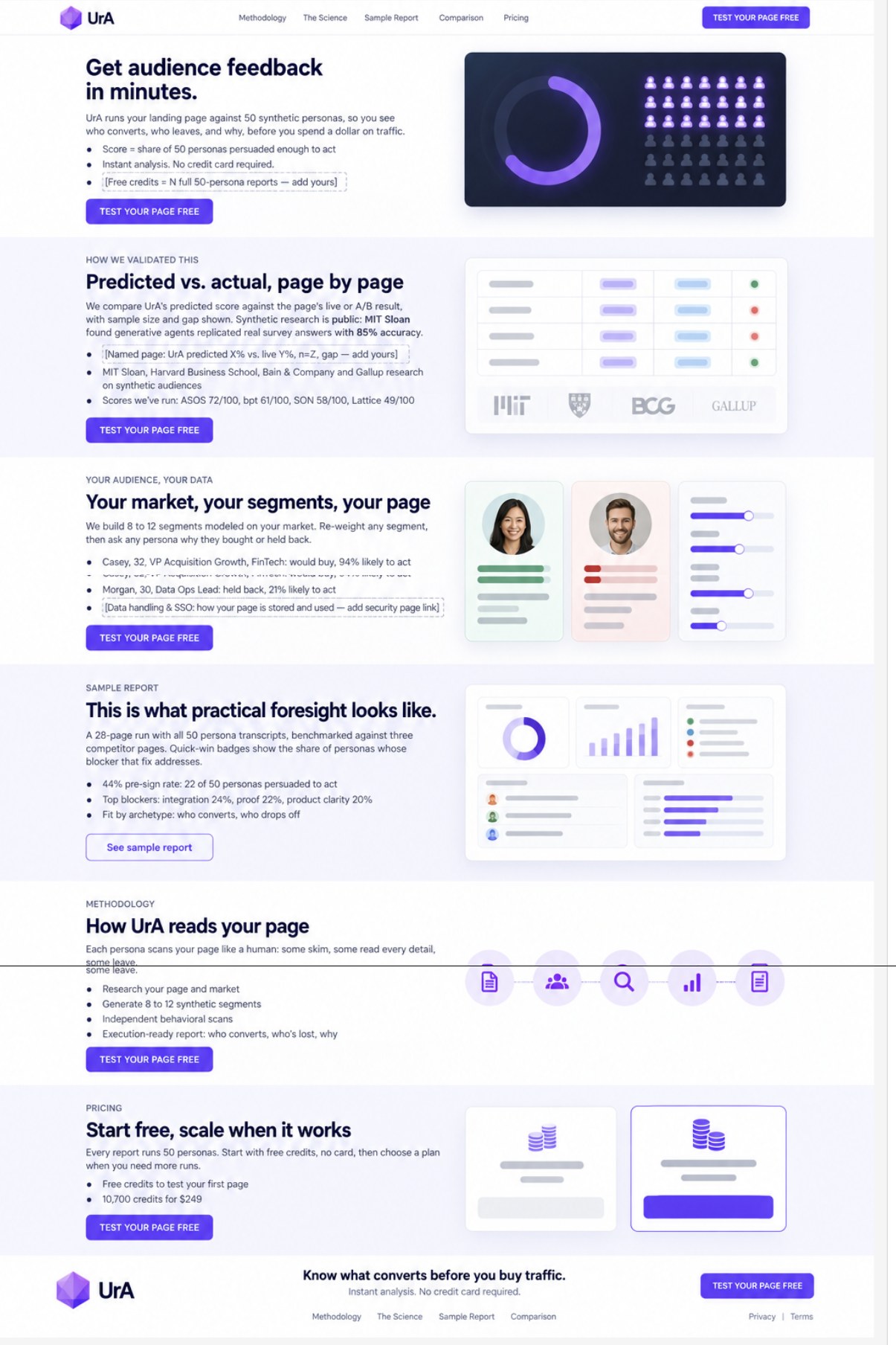
Your page next
Run this on your landing page
100 simulated visitors, the same report, results in minutes. No credit card required.
Test your page freeURA · Feedback report · uralabs.app · Oct 13Synthetic audience · 100 members · uralabs.app